Saturday, April 17, 2010
Weedy thoughts
As I learn more about plants and permaculture, this question becomes quite complicated. I’m getting a re-education about “weeds”. I’ve had to reconsider my attitude toward many plants in the light of new evidence. When we moved here, I saw sumac as an aggressive root-suckering plant, and autumn olive as a thorny invasive pest. Burdock was something to be given a wide berth, especially when wearing a wool sweater. Now I know sumac provides a refreshing beverage, stabilizes soil, and provides food for honeybees at a time when few other plants are blooming. Autumn olive is a nitrogen-fixing shrub, hosting microorganisms that pump nitrogen into the ecosystem. Its berries are popular with wildlife, and a related species is used as food for humans. Burdock is simply a medicinal, edible wonder plant; see its virtues as described by Susan Weed.
Native, invasive, naturalized, pest: all categories of species we like to use. The native plant proponents would have us go back to a pre-Columbian flora. Any more recent arrivals are treated as pathogens – pull them, spray them, just get rid of them. Are they pathogens? Is baby’s breath an infection of ecosystems along the Lake Michigan shoreline? In our bodies, pathogens move in when our immune systems are weakened. Numerous cultures can teach us that sickness is not inevitable, as American medicine seems to believe. Healthy ecosystems are resilient, and resistant to minor changes, so population explosions of a single species must be a sign of something wrong. What is out of balance in these ecosystems that allows one species to become so dominant? Joe Jenkins has an interesting view of humans as pathogens in his book, Balance Point.
I’m convinced that plants simply live where they can, or are needed. If they can fulfill a role (a.k.a. fill a niche) in an ecosystem, they do. If a non-pre-Columbian plant species get established, it may be because the existing ecosystem has changed significantly. Yes, spotted knapweed can dominate a landscape, and Phragmites can take over wetlands. But knapweed has a deep taproot and can bring minerals back up to a starved topsoil. It will eventually decline as soil organic matter builds up. It is also one our biggest sources of nectar and pollen in late summer, making a honey harvest possible. It has taken over the old farms around here because the soils won’t support much else but lichens. It’s soil-building starting from square 1 ½. Phragmites thrives along shorelines and wetlands with high levels of nitrates. It is actually cleaning up the excess nutrients before they can cause a destructive algae bloom. Now, where are those nitrates coming from?
Permaculture designers and gardeners use properties of various plants to imitate a naturally-occurring ecosystem. There are nutrient accumulators that bring up nutrients with long tap roots, ground covers that hold soil, nurse plants that protect young perennials, shrubs and trees, insectary plants that attract beneficial insects, and the well-known nitrogen fixers. So there are reasons to keep burdock, lamb’s quarters, autumn olive, clover, yarrow, Queen Anne’s Lace, and many others, even stinging nettle. Perhaps we should not be so quick to judge, or slap on a label like “weed” or “invasive pest”. Perhaps these plants are trying to tell us that these ecosystems are in need of serious help! Yet we insist on shooting the messenger again, or in this case, pulling it up by the roots. It’s been said that a weed is just a plant whose virtues have yet to be discovered. If that’s the case, there are few if any weeds.
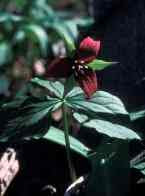
So where does that leave me in my new education? Native vs. non-native has a much diluted meaning. Goldenrod is a valued friend, and knapweed stays where it can for now; the bees love them both. Sumac has a home on the steep hill in the powerline right-of-way crossing the property, and autumn olive is to be left alone to accumulate nitrogen in those nearly-bare areas. Many others are welcomed for their food or medicinal value, or for just plain beauty, like the thousands of Dutchman’s breeches blooming in the woods right now. Who am I to say what stays or goes? The land knows what she needs, and the plants are her way of healing herself. To paraphrase John Burroughs (I think), when you pull up one plant, you find it hitched to everything else, including yourself. Now, what happens if you pull hard on your own shoelaces?
Sunday, April 11, 2010
A sweet, sweet day
Our last sap collection didn't add up to enough to boil for syrup, so I boiled the 4 gallons down to two, and pitched in a red wine yeast. It's bubbling merrily along.
It was a bittersweet day, too. Zelda's hive came through the winter very weak, and when I checked today, there were literally a half dozen bees flying around the entrance. When I opened the hive, there was nobody home. They had built comb at a crazy angle relative to the frames in one hive body; guess they didn't really know how to do it without foundation to guide them. Rebuilding those frames has been in the plan, so I brought it down to the garage and we had our first honey harvest today! The girls were just giddy with excitement over all that honey. We cut the comb out of the frames at first, but as things began to fall apart, we all dove in with our hands. Six very sticky hands. LR washed her hands in the pond so we could open a door and get in the house!
Version two features a paint straining bag suspended from a freshly-cut tripod. By morning, things should be well-filtered.
Saturday, April 3, 2010
Parsnip follow-up
Slice half an onion, more or less, or chop up a bunch of spring leeks.
Peel and slice 3-4 good size potatoes, or whatever's left in the root cellar.
Scrub and/or peel the straightest parsnips of the scrawny lot you just dug up so you have at least 2 cups, and slice.
One could add a stalk of celery, but I didn't.
Sautee the onion in your oil of choice in a soup pot until nearly transluscent, then add potatoes and celery, and a cup or so of water so they don't stick.
When the potatoes are about half cooked, add 2 cups (or more) of vegetable stock, and the parsnips.
Cover and simmer until potatoes and parsnips are cooked, then puree (easiest with a stick blender).
While the potatoes are cooking, fry 6 strips of bacon until crisp. Break these up in bits and add to the soup just before serving.
Add a quart or so of water to increase the volume. We have some dairy sensitivities, but one could add a cup or two of Shetler's whole milk to make the soup rich and creamy.
Sprinkle in generous amounts of your favorite herbs. I used oregano, parsley and dill (no marjoram left). Now's the time to add the bacon.
Warm gently for several minutes and serve with a sprig of freshly picked parsley, and perhaps a chunk of good sourdough bread for dipping.
Eat slowly, with gratitude, and dream of spring greens, sunny days, and soft warm rains.
Saturday, March 27, 2010
The Spiral of Gardening

Friday, March 19, 2010
Sugarin'!

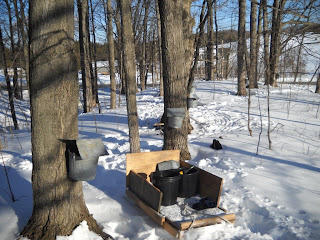
It's officially spring, or at least late winter. On March 3rd, I sowed 4 flats of alliums in the greenhouse (at work, sshhh!), and on March 4th, I tapped 31 of our sugar maples. In a week, we had collected almost 90 gallons of sap; a slow start. The next week, we got 26. Then the night temperatures stayed above freezing thanks to unseasonably warm weather, the flow just about stopped. I sowed tomatoes in soil blocks tonight (at home this time), and the temps have been falling. Things are looking good for the next few days, and the moon is waxing for another week, so I'm hoping for a good run. Meanwhile, the garlic, rhubarb and daffodils are poking their heads up.

The sled is made from found lumber and some old skis.
This time of year is a strange mix of activities. Planting, waiting, planning, watching, gathering & boiling. Wonderful rituals, and good honest work. It feels so good to be outside every day, especially hauling buckets of sap. Last year, we collected over 300 gallons and drove every drop to the family sugar shack 25 miles away. Lots of work, but we brought home over 7 gallons of syrup. We just made it, too; I opened the last pint two days ago!

Thanks, maples, for a sweet gift.
Tuesday, February 16, 2010
A REALLY HOT Investment Idea!
Then we add another great folly of our time: biomass fuels. Recently, we discovered that when you burn food for fuel, the food, corn in this case, becomes a commodity. Well, OK, corn already was. Our American appetite for motor fuel almost took the corn tortilla out of Mexican culture. Our local power company is in favor of a biomass conversion plant, where who-knows-what would be burned to heat water to make electricity.
In another column, soil fertility has been declining for years. That corn probably wasn't worth eating anyway, so poor was its mineral content. Thanks to the Haber process, we have a handy way to make nitrogen fertilizer out of, guess what ... natural gas. Thus, our soil fertility program is tied to the price of fossil fuels, and subject to international disputes (see Russia vs. the rest of Europe). While nitrogen fertilizer gets more and more expensive, we mine the mineral apatite as a phosphorus source. While you're waiting for Peak Oil, keep an eye out for Peak Apatite!
I have another idea. Listen carefully 'cause I'm only gonna say this once, "Invest in the soil!"I repeat, "INVEST IN THE SOIL!"
Here in northern Michigan, one does not need to look far to find a farm that would have benefitted from the advice of Bill Mollison and David Holmgren, the founders of permaculture, instead of the advice of John Deere, the inventor of the moldboard plow. It all comes back to those teeming millions of bacteria in the soil. When soil is disturbed (plowed, disced, rototilled), the foods for the bacteria get homogenized. It's like a dirt smoothie, and they can get all they need very easily. They grow like crazy, and as they grow, they consume organic matter. When the forests up here were logged and the land sold to immigrant with dreams of farms, the plows mixed the soil and the bacteria ate that precious 2-3 inches of topsoil. The potatoes yielded less and less, and the immigrants left for town, my ancestors among them. Nature has been trying to repair the loss ever since, with spotted knapweed and autumn olive, among other remedies.
Let's learn from history. We are living in an exciting wave of new agriculture: small farms, local markets, caring people. Those of us with gardens are right there with them. We are going to succeed in an era of high energy costs by our willingness to work at it. I offer one basic principle that farmers in India and China have been using for thousands of years: compost, compost, compost.
Organic matter in the soil increases water holding capacity, adds mineral ion exchange capacity, and provides homes and food to billions of microrganisms that provide plants with slow-release mineral nutrition in just the right form. Translated, this means, if your soil is rich in organic matter, you don't need to water as often, any nutrients you apply will stay in the soil instead of leaching out with rains, and you probably won't need to apply fertilizer anyway. On the balance sheet, soil organic matter adds up to work you don't have to do!
Here's my great investment idea: on the tiny cultivated fraction of my 6 acres, I'm going to work on building soil organic matter. Household food scraps and garden trimmings go in the compost. The compost will, of course, go on the garden. The worm bin gets shredded paper and junk mail (no shiny inserts of course). The worm castings will be made into high-quality compost tea and potting mix. Leaves, lawn clippings and such get piled in windrows on ground that will someday be garden. Soon, we'll have some cute little furry manure producers (a.k.a bunnies) who will add to the garden soil. After much permaculture reading, I've adopted a greater tolerance for autumn olive, a nitrogen-fixing shrub. I also plan to add more of the soil-building plants listed by Toby Hemenway in Gaia's Garden. If I can swing it, nothing organic will leave this place!
We shouldn't burn biomass for energy if we can help it. Since burning adds yet more CO2 to out beleagured atmosphere, we shouldn't burn ANY plant material, paper, cardboard, etc. that could be used another way. As individual landowners, even small ones, and as communities, we need to invest in the land that might sustain us. I say "might" because we've neglected this savings account for more than 50 years, and we're paying the price. Our land is our best investment. Carefully tended, it will provide riches in the form of good food for years to come.
So start a backyard compost pile or worm composting system. Everything, I mean EVERY thing that will rot needs to go in a compost pile, or be spread lovingly on the land in a sheet mulch. If we produce more compostables than you can use, we need to find a way to get them back to the farms that support us. In an ecosystem, all matter is recycled within the system. So must it be with our communities as well.
Monday, February 8, 2010
It's Almost Time ...
LR and I asked one of the trees, "Is it time yet?" The tree replied, "ARE YOU CRAZY??"
I'm planning to add about 12 more trees to the Sugar Trail, as we call it; we could end up with about 50 gallons of sap per day. We'll be boiling at a friend's shack this year. Next year, I hope to boil here. Anybody know of a small evaporator for real cheap?
Soon, the hours of trudging through snow with heavy buckets, breathing the steam heavy with the scent of syrup, smelling of woodsmoke for days. Soon, drinking the sap as a ritual spring tonic, flushing out the crud of winter like so much dirty snow. Soon ...