Friday, October 28, 2011

Free food this fall!


Five pints of autumn olive berry jam from the bushes around the garden. Yum!


Apples from under the neighbor's tree. Will they last until I find a cider press?


About 2/3 bushel of English walnuts from another neighbor's tree. We'll dry them and nibble all winter long!
Get to know your neighbors and their plants! Make friends and trade stuff and skills. Begin the weave the fabric that will make this world a lot more fun.

Friday, September 23, 2011

Sugar Shack update

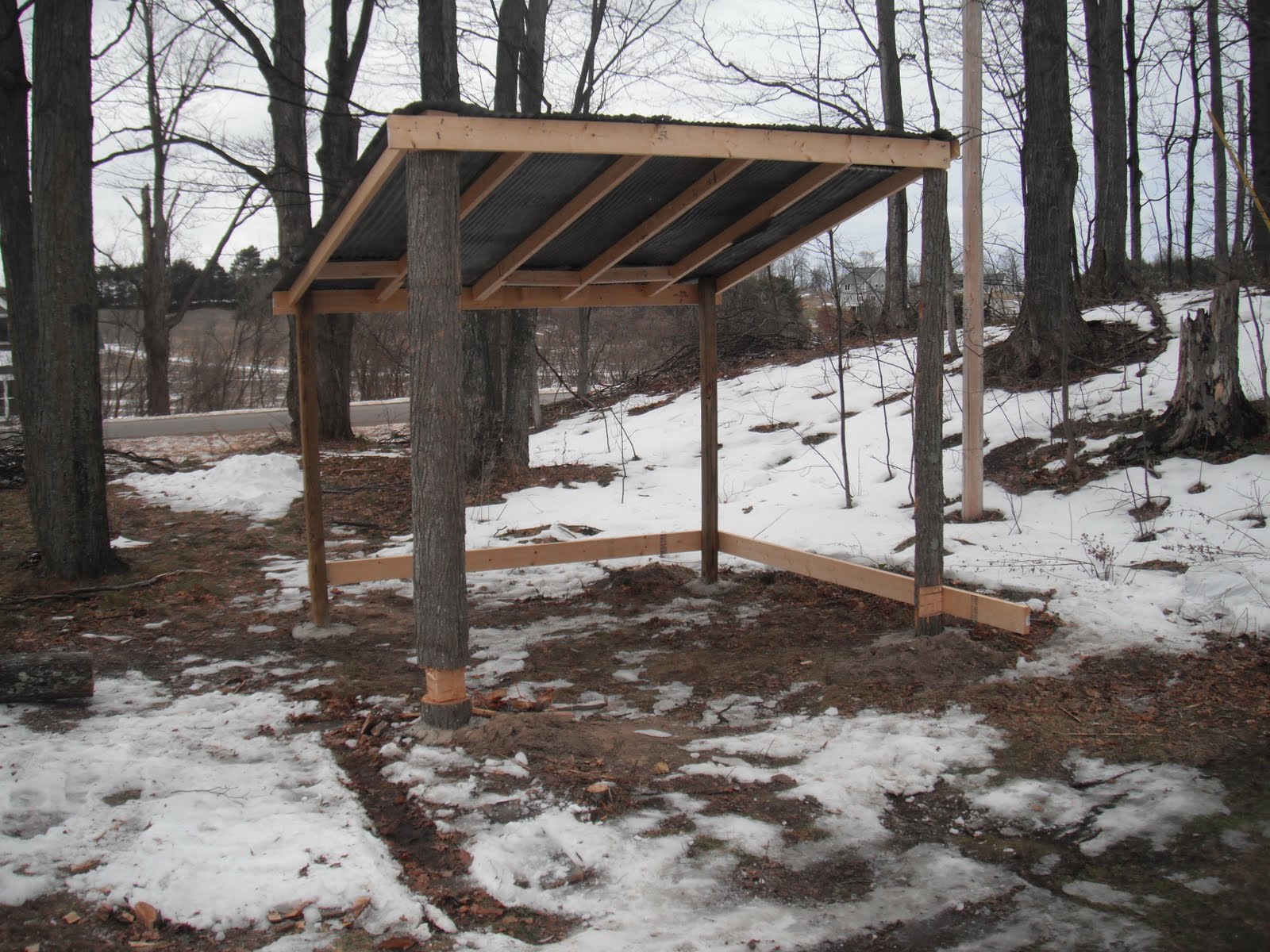
Back in January, I left you with a picture of four posts and a roof, finished in a brief thaw. By the time we tapped in March, the shack had FEMA-style sides made with tarps.


We had a barrel-style stove, and burned mostly cut-up pallets. It did well, boiling over 550 gallons of sap. The pan only holds 18 gallons, so there were lots of late nights.


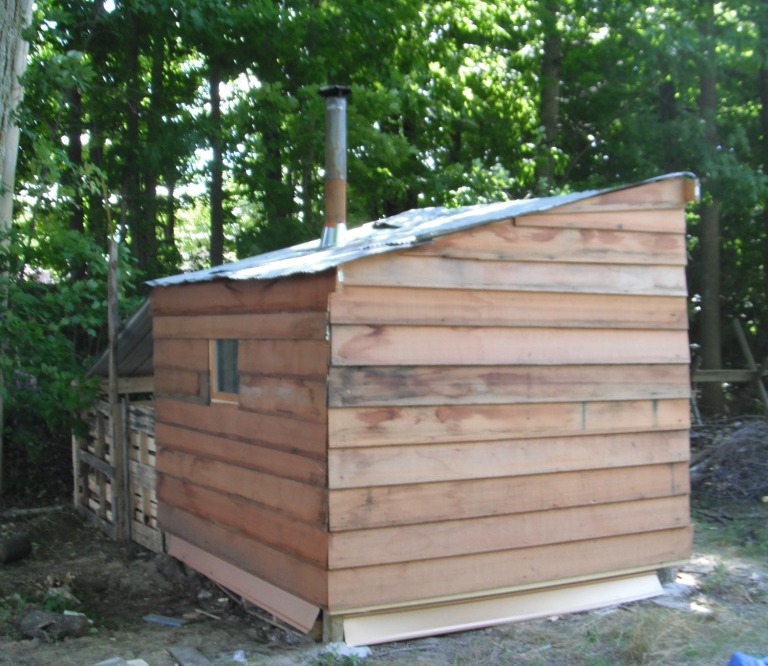
Since then I've been making some improvements, like recycled redwood siding:


The door and frame were left behind by the previous owner. Thanks!


The best shot of all - it's done!

Wood storage is on the back side, in the shade. The top panel with the window tilts out to let out steam when we're boiling. Can't wait to make syrup in style next year!

Saturday, September 17, 2011

Chicken update (or whole story)

So I couldn't stay away all that long. Too much to say I guess, and a few things to show off.

Come sit for a spell, dear reader, and I shall relate a tale of innocence and innocence lost, of a despicable act of murder, and of resilience. This is the story of our first adventure with raising chickens.

My tale begins in April of this year, when I put the finishing touches on our hen house and the fencing for an outdoor run,

We were invited to adopt two mature hens from a colleague in town, who had too many hens for his space. So with giddy innocence, we took in Elizabeth and Annabelle, who promptly started giving us eggs.

Our spring day-old chick order arrived on April 28th, so in a couple weeks we also had six more tiny and adorable lives to care for. All went fine until the first week of June, when Annabelle, the lovely Buff Orpington died for no apparent reason. She had even laid an egg a few hours before. The remaining hen, a Barred Plymouth Rock, seemed lonely, so I hatched a plan to put the chicks, now 6 weeks old, in a pen adjacent to hers. I even rigged a little door so the younger birds could mingle and meet their elder, who frankly wasn’t all that nice to them. On a Monday morning, about June 12th or so, LR found a scene of ghastly mayhem and mass murder. Four of the six pullets were dead, and a fifth was mortally wounded. Only one chick had been eaten. She also found evidence the identified the attacker in the form of a big pile of raccoon shit. The family was distraught, and I spent the morning cleaning up the mess. One of the hardest things I’ve had to do was bury my 6-year-old’s favorite chicken.

In the meantime, we had ordered 25 chicks to raise as broilers. I quickly changed to order to replace the lost layers, and those chicks arrived at the end of June. Be advised that 25 chicks in brooders in July REALLY stink up the garage in a hurry! Our flocks now consist of 1 Buff Orpington, 4 Black Austrolorps, 2 Rhode Island Reds and a Silver-Laced Wyandotte for layers, and 18 Rhode Island Reds as meat birds.

I elected to get RIRs for meat on reports that they taste really good, and on comments by Carol Deppe in The Resilient Gardener the chickens don’t acquire a really beneficial fatty acid profile (more omega-3 fatty acids) until they are past the 8-week butchering age for Cornish cross broilers. I plan to butcher them sometime in October. Until then, they are doing fertility duty in the expanded Zone 2 garden (it’s a permaculture thing). Eat, grow and poop, that’s all I ask. Next year we’ll have some better soil to plant in.

The garden is surrounded by four-foot wire fence and a strand of electric wire to prevent invasion and more murder by Evil Raccoons or marauding coyotes. Note the welcome presence of an autumn olive next to the pen! The girls go nuts for the berries.

Just today, the 18 RIRs got to run around in a fenced-off section of the garden so they can poop-n-scratch. They'll stay that way, with the tractor as an overnight shelter, until The End.

Check back in October for the Egg Watch and more adventures!

Thursday, March 31, 2011

Adios Blogosphere?

So it's been 3 months since my last post. We have 5 rabbits now, and chickens very soon. The sap is flowing generously so I don't spend much time in the house. As an austerity measure, we canceled the internet connection at home. I probably shouldn't do blog posts at work, and I barely have time to eat lunch anyway. For the forseeable future, this is the last post from Snowy Hollow. Know that all is well and very busy. I leave you with these to-dos:

  1. get out of debt before the economic house of cards crumbles (may you have better luck than me)

  2. get to know your neighbors, even if they don't think like you do (reverse the Googlization of the world!)

  3. get a good pair of boots and a good bike

  4. take a permaculture class and REALLY study it

  5. get chickens

So long, and stop by if you're ever in the neighborhood!

Saturday, January 1, 2011

Sugar Shack Phase One

Here it is so far! No driving 20 miles to the family's sugar bush to boil our sap this year. Two years in a row I've messed up my back doing that. Even better, this shack is downhill from just about all our maples. Did you know sap (mostly water) weighs about 8 pounds per gallon? I'm finally getting smart!

I took advantage of a break in the weather to finish the roof today. The taller posts on the south side are from a maple that was cut last summer. This year, we'll have a tarp-sided lean-to, but I have a lead on barn siding to be added sometime this year. There's also a framed steel door to be added. The things people leave behind when they move out!
By now you know it all has to fit into a permaculture-style scheme around here. Each element of the design should serve more than one function. So, in addition to boiling sap in early spring, the shack will also be a small greenhouse. I have some windows to frame in on the south side. Just picture an outward-slanting glass wall on the bottom two-thirds of the south wall. The top third needs to open to let the steam out. I figure I can get it warm enough in March and April to start some spring greens, and maybe start some peppers by late April.

If we ever have enough of anything to sell, I'll add a canopy and table on the west side for a little market stand. Oh wait; if I do that then the guv'ment inspector people will want to call us a farm. Y'all just stop by and leave something in trade instead!


In a mixture of Anishinabeg and Hebrew traditions, we'll boil sap under a "roof that leaks starlight" this year. Call it our "Sap Sukkah"! I'll have to plug all those holes when things warm up. The beauty of scrounged sheet metal.

In other permaculture principles, I saved some of our wood from an uncertain future. The County road crew was trimming trees since there wasn't any snow to plow, so I asked them to leave the branches from our trees and the neighbor's. They also left me about 5 yards of wood chips! Now I just have to get it outta the driveway!

Monday, December 27, 2010

Twas a good Yule!

We hope yours was too. As you can see, we got a new camera!


I built this playhouse for the girls last summer out of scrounged or salvaged wood, used windows and some "boughten" lumber. Don't look too closely; I'm a biologist, not a builder.

We hosted a Solstice / Advent Spiral gathering for our homeschool group. I'm not sure how it worked 'cause I was off replacing a tire that developed a leak after hitting a gargantuan pothole.
Our favorite family gift was Wildcraft, a cooperative herbal foraging game from the nice folks at learningherbs.com. It's great fun for a wintry day, beautifully decorated, and really nice because the game ends when everybody makes it back to Grandma's house!
Now my mind turns to garden design and seed catalogs. But first I need to get a roof on the sugar shack so we can boil sap here!

Tuesday, December 7, 2010

The virtues of Elaeagnus umbellata

Much to the chagrin of the native plant lovers, I've had a conversion since we move in here at Snowy Hollow. I've come to appreciate Elaeagnus umbellata, know far and wide as autumn olive, the fast-growing invasive, thorny shrub that forms dense stands if left to its own devices. Years ago, I knew it as host to fruit-eating birds in fall and early winter. My first Bohemian Waxwings and Pine Grosbeaks were found in autmn olive thickets. As a kid, we planted one in the yard in northwestern Pennsylvania. Somewhere along the road, I bought into the "evil invader" line.
So, when I found a few on this land, I thought about taking them out. Then I started looking at them through the eyes of the ecosystem. I learned they fix nitrogen, a most valuable trait in restoring worn out and devastated soils. They can also act as a nurse plant for young trees, shading them lightly, protecting them, and providing extra nitrogen as they get started. And if that's not enough, the berries have 17 times the lycopene content of tomatoes! Autumn olive may be seen as invasive in some eyes, but I hold it to be an ecosystem healer and a free health food! We made a few pints of autumn olive berry jam this fall.

I'd highly recommend trying it; sort of a complex tart flavor that can be balanced with as much sugar as you want, but don't overpower it.
So here's what I've learned from Elaeagnus umbellata: dense growths of any species are a sign that it has traits or abilities that make it well suited for those places, and dense growths of anything don't last long. All ecosystems are trying to build fertility as they go through the process of ecological succession. In the case of autumn olive, it grows well where native ecosystems have been displaced and, very likely, where soils were trashed by efficiency-minded farming practices. It grows well in places that need its healing, nitrogen-fixing skills. If you seek to get rid of it, acknowledge this and replace it with something native that can do the same job. I'd also bet that this plant will put itself out of business as the fertility of the ecosystem improves.
One might come to another anaolgy involving "aliens": they do the jobs that natives (a.k.a. gringoes) can't or won't. Why do we depend on migrant labor to tend and harvest our food? Because we're incapable or too damn lazy! Let's not deport them unless we're prepared to take their places. So instead of annihilating a very helpful plant in the name of botanical purity (one could really make some analogies here!), consider what it does; then make some jam!