Saturday, January 1, 2011

Sugar Shack Phase One

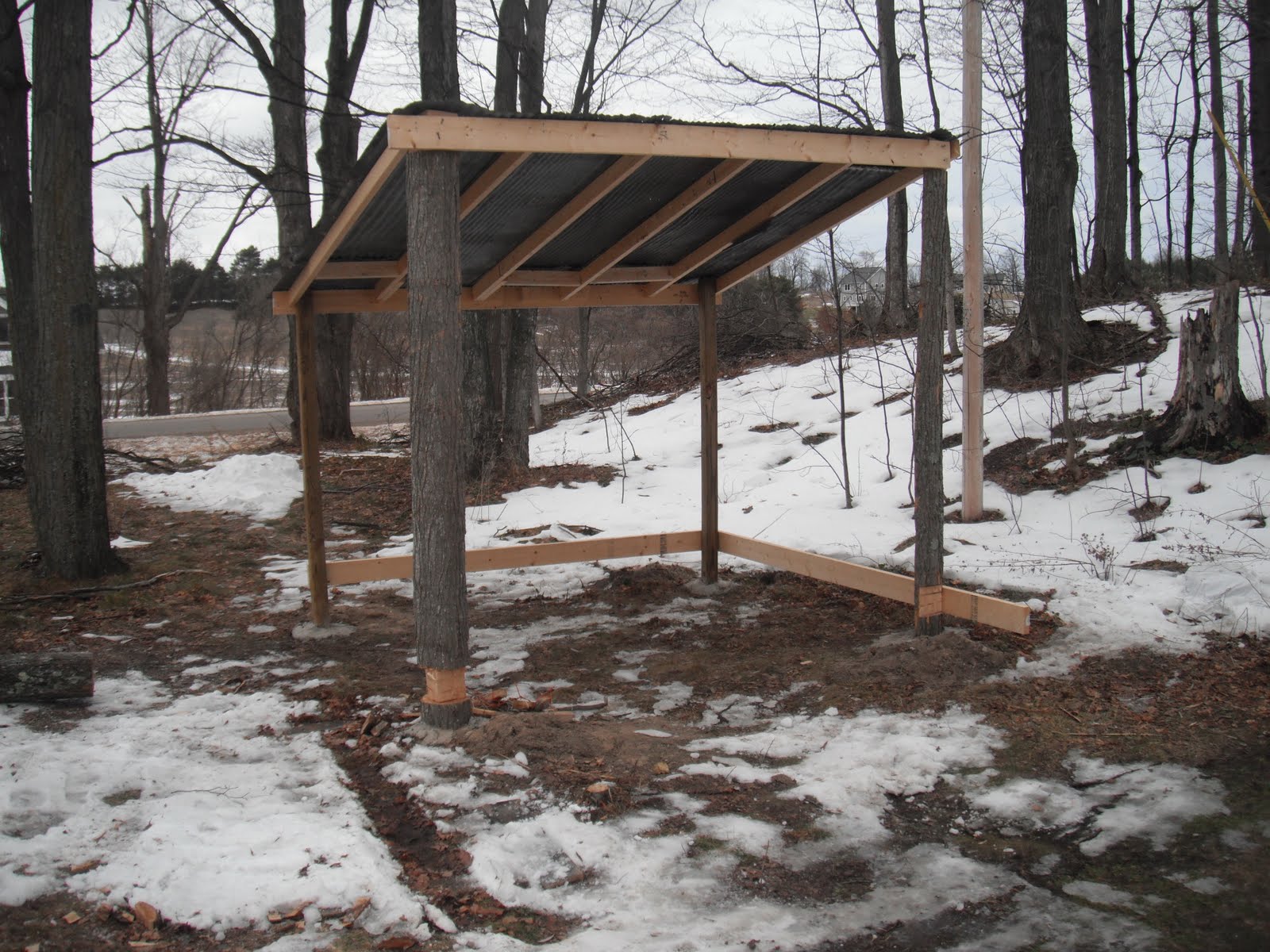
Here it is so far! No driving 20 miles to the family's sugar bush to boil our sap this year. Two years in a row I've messed up my back doing that. Even better, this shack is downhill from just about all our maples. Did you know sap (mostly water) weighs about 8 pounds per gallon? I'm finally getting smart!

I took advantage of a break in the weather to finish the roof today. The taller posts on the south side are from a maple that was cut last summer. This year, we'll have a tarp-sided lean-to, but I have a lead on barn siding to be added sometime this year. There's also a framed steel door to be added. The things people leave behind when they move out!
By now you know it all has to fit into a permaculture-style scheme around here. Each element of the design should serve more than one function. So, in addition to boiling sap in early spring, the shack will also be a small greenhouse. I have some windows to frame in on the south side. Just picture an outward-slanting glass wall on the bottom two-thirds of the south wall. The top third needs to open to let the steam out. I figure I can get it warm enough in March and April to start some spring greens, and maybe start some peppers by late April.

If we ever have enough of anything to sell, I'll add a canopy and table on the west side for a little market stand. Oh wait; if I do that then the guv'ment inspector people will want to call us a farm. Y'all just stop by and leave something in trade instead!


In a mixture of Anishinabeg and Hebrew traditions, we'll boil sap under a "roof that leaks starlight" this year. Call it our "Sap Sukkah"! I'll have to plug all those holes when things warm up. The beauty of scrounged sheet metal.

In other permaculture principles, I saved some of our wood from an uncertain future. The County road crew was trimming trees since there wasn't any snow to plow, so I asked them to leave the branches from our trees and the neighbor's. They also left me about 5 yards of wood chips! Now I just have to get it outta the driveway!

Monday, December 27, 2010

Twas a good Yule!

We hope yours was too. As you can see, we got a new camera!


I built this playhouse for the girls last summer out of scrounged or salvaged wood, used windows and some "boughten" lumber. Don't look too closely; I'm a biologist, not a builder.

We hosted a Solstice / Advent Spiral gathering for our homeschool group. I'm not sure how it worked 'cause I was off replacing a tire that developed a leak after hitting a gargantuan pothole.
Our favorite family gift was Wildcraft, a cooperative herbal foraging game from the nice folks at learningherbs.com. It's great fun for a wintry day, beautifully decorated, and really nice because the game ends when everybody makes it back to Grandma's house!
Now my mind turns to garden design and seed catalogs. But first I need to get a roof on the sugar shack so we can boil sap here!

Tuesday, December 7, 2010

The virtues of Elaeagnus umbellata

Much to the chagrin of the native plant lovers, I've had a conversion since we move in here at Snowy Hollow. I've come to appreciate Elaeagnus umbellata, know far and wide as autumn olive, the fast-growing invasive, thorny shrub that forms dense stands if left to its own devices. Years ago, I knew it as host to fruit-eating birds in fall and early winter. My first Bohemian Waxwings and Pine Grosbeaks were found in autmn olive thickets. As a kid, we planted one in the yard in northwestern Pennsylvania. Somewhere along the road, I bought into the "evil invader" line.
So, when I found a few on this land, I thought about taking them out. Then I started looking at them through the eyes of the ecosystem. I learned they fix nitrogen, a most valuable trait in restoring worn out and devastated soils. They can also act as a nurse plant for young trees, shading them lightly, protecting them, and providing extra nitrogen as they get started. And if that's not enough, the berries have 17 times the lycopene content of tomatoes! Autumn olive may be seen as invasive in some eyes, but I hold it to be an ecosystem healer and a free health food! We made a few pints of autumn olive berry jam this fall.

I'd highly recommend trying it; sort of a complex tart flavor that can be balanced with as much sugar as you want, but don't overpower it.
So here's what I've learned from Elaeagnus umbellata: dense growths of any species are a sign that it has traits or abilities that make it well suited for those places, and dense growths of anything don't last long. All ecosystems are trying to build fertility as they go through the process of ecological succession. In the case of autumn olive, it grows well where native ecosystems have been displaced and, very likely, where soils were trashed by efficiency-minded farming practices. It grows well in places that need its healing, nitrogen-fixing skills. If you seek to get rid of it, acknowledge this and replace it with something native that can do the same job. I'd also bet that this plant will put itself out of business as the fertility of the ecosystem improves.
One might come to another anaolgy involving "aliens": they do the jobs that natives (a.k.a. gringoes) can't or won't. Why do we depend on migrant labor to tend and harvest our food? Because we're incapable or too damn lazy! Let's not deport them unless we're prepared to take their places. So instead of annihilating a very helpful plant in the name of botanical purity (one could really make some analogies here!), consider what it does; then make some jam!

Monday, September 13, 2010

The Edge of the Petri Dish

My friends, I have something to tell you. As you know or can easily imagine, we live in a world with finite resources. And yet, our economy is based on an ideal of continual growth. For that to occur, someone needs to be selling something, and others need to be buying it, always, whether we need it or not. Cheap resources get converted into products. Where do the raw materials for those products come from? Earth; the water and soil of the planet. Everything we eat, breathe, drink and buy is some form of processed sunlight, in combination with soil and water.

As you can imagine, with about 7 billion people on the planet now, we are starting to run out of stuff. In some places, it’s clean water. In others, it’s topsoil. We are reaching the limit of the planet to support us, at least in our extremely consumptive Western lifestyle. Ecologists call this “carrying capacity”. On the graph below, the curvy line shows population over a period of time (the horizontal dimension). Note that the population reaches a certain level and begins to decline. After that it oscillates around a certain number, represented by the horizontal line. That number is the carrying capacity.

If this were a graph of GDP, the upward trends would represent economic growth, and the downward portions would signify recessions. Consider what we’ve been hearing lately: “long, slow recovery”, “double-dip recession”. Seems like recessions hit about every ten to fifteen years, though I may be mistaken. I’m just an ecologist. If we were to graph GDP over the last 200 years, might it look like the graph above?

I didn’t just summon you here for an ecology / economics lesson. By the way, Marston Bates eloquently reminded us they are the same thing. I wanted to share what I’ve been learning since last winter. One of the big resources that will soon limit our potential for growth is oil. Consider for a moment, or a day, how many things in our lives rely on fossil fuels, especially oil. Now the bad news: there is a growing body of evidence that global production of oil is at or near its peak, and will begin to decline in the next few years. We have every expectation that demand will not decline, however, and when demand begins to exceed supply, prices go crazy. Read this again carefully: we’re not about to run out of oil; we’re about to run out of cheap oil. Case in point: the summer of 2008. There are many others if one wishes to dig them up. Yes, we seem to be up against the edge of the Petri dish.

Before you panic, I’d like you to do one or more of several things: visit http://www.transitionculture.org/ and watch the movie “In Transition”, or better yet, read The Transition Handbook by Rob Hopkins. I found section one to be very helpful in explaining the combined threats of Peak Oil and climate change. Section two is an essential reminder that dealing with what we are facing involves a grieving process and recovering from addiction (to oil). The second helpful thing I’ve found is The Archdruid Report, a blog by John Michael Greer. His wisdom and wit are delightful and thought-provoking. A third helpful thing is to attend one or both of the speakers in Traverse City this month.

Another very helpful and hopeful way to deal with the idea of economic, social and environmental upheaval is to remember the ancient wisdom about the healing and nutritive values of plants. Most of our pharmaceuticals are, in some way, derived from oil. They all rely on cheap oil for manufacturing and transportation. One of the solutions or inevitable outcomes seen by those peering into crystal oil drums is that production of just about everything will become much more decentralized, even hyper-local. Enter the beauty of knowing how to use a few herbs.

In my yard, I have plants that will nourish me (dandelion and burdock), treat wounds (yarrow), stabilize blood pressure (dandelion and garlic), reduce the pain of insect stings and bites (plantain), help one’s body use iron well, thus treating anemia (dock), reduce fevers (catnip), help treat colds and flu (elderflower and Echinacea), and many more I’m just beginning to learn. If we can’t get our prescribed pharmaceuticals, let’s go walking in the woods and fields. Those of us who know a few or some of these plants are in a position to help others. We might become the village herbal healers.

There’s a great deal to digest in the news that oil supplies will soon get precarious, or downright undependable. Take your time; go through the stages of panic and grief. After all, we may need to grieve the loss of a culture (also known as suburban sprawl). Talk about this with trusted friends, but they’ll probably look at you like you’re crazy. Get to know your neighbors, too. You might even share a favorite herbal tea with them. Friends, our actions now will determine whether we smack hard up against the wall of resource limitations, or whether we slow gently to a stop on our current path, and have time to steer a course toward a more balanced future.

(Previously published for the Herbal Alliance of Northern Michigan.)

Been building, not blogging

If anyone wonders about the lack of activity on this blog, rest assured I'm still here. I've been working on summer projects, like a playhouse for the human girls, and a hen house for the feathered girls (next year). It helps to get some things done before the snow flies. I'd like to have pictures, but LR dropped the camera in a mug of tea a few weeks ago.
We harvested about 25 pounds of honey last month, too. Thanks, bees!

Sunday, August 8, 2010

Profound words

"Water and dirt are the most important things. Kind of like our mom and dad, and everybody in the whole world are the kids. Except some of the kids are treating them badly. A whole bunch of children are treating them meanly.
"Those plants and rocks and trees are my brothers and sisters. I want to write a book about it when I learn to write."
- words of LD, age 5, as best I could capture it.

Sunday, August 1, 2010

How long can you tread water?

Years ago, Bill Cosby did a comedy routine about Noah and his hypothetical neighbor. Picture Noah, working away on the ark, in suburbia. From memory:

Neighbor: “What’s this?”
Noah: “It’s an ark.”
Neighbor: “What’s it for?”
Noah: “I can’t tell you.”
Neighbor: “Right. Could you get it out of my driveway? I gotta get to work! (Pause) Really, could you give me little hint?”
Noah: “How long can you tread water?”

These days, I feel a lot like Noah may have felt, knowing what was to come and how it would affect people. Since last December, I’ve been attending a book study group/bunch of concerned people that has been reading Rob Hopkins’ The Transition Handbook. In it, Hopkins reviews the evidence for the twin impending threats of climate change and peak oil, and the evidence is pretty damn compelling. I have read it, and I accept the evidence as sound. This is not the same as “I believe”; it’s a case of “I have a pretty good idea (borrowed from the movie “Dogma”).
If you’d like to read the arguments for yourself, read Hopkins’ book and The Long Emergency by James Howard Kunstler. Review the past several months of weekly posts at The Archdruid Report. Don’t take my word for it, but start reading soon. The bottom line on climate change is we’re in for warmer, probably drier times in the short term, with droughts, mere water shortages, probable crop failures and other disruptions to the food supply, and certainly thousands, if not millions, of climate refugees.
As far as Peak Oil, we may have passed the time when worldwide oil production has begun to decline, while demand continues to increase. According to Kunstler, we are probably in for a period of uneven supply, and wildly fluctuating prices. The $140 per barrel oil of 2008 will seem like kid stuff. Oil supplies will not run out for a few more decades, but oil and shortly after, natural gas, are going to become more and more scarce. Some have said we have as little as two years.
Imagine how Noah must have felt, knowing that something completely disruptive to our culture is coming. I wonder how he looked at his neighbors, what he felt. If it was "you're gonna get what's coming to you, decadent slothful sinners", then I can empathize. Our way of life is based on cheap energy, particularly oil. We've been pretty lousy inhabitants of Planet Earth, rather like the spoiled "entitled" brats who trash hotel rooms. I also care about people, and hate to see suffering. I guess I would settle on "it's time to face the music", but I'm an oil-sinner too.
How do you carry around a secret like this? I would tell everyone I meet, but I (and others) risk being called Chicken Little or Boy Crying “Wolf”. We’ve had a taste of the economic chaos that lies ahead: corporations failing right and left, huge banks failing, government acting as fast as it can to do too little too late, or worse, something totally counterproductive. Hopkins offers two chapters on how we might deal with our grief for the loss of a way of life. For those who might pray for salvation, either technological or spiritual, I offer what I have learned from the Archdruid: “No one’s coming, Harry” (from Harry Potter #3). No one is going to bail us out of it this time.
So how does one bring up the notion of Energy Descent, coming down off our addiction to oil? I do believe, for the planet’s sake, it’s a good thing. But how will I get to work in the winter? Will I have a job? Will it matter? Will the bank holding my mortgage fail, and I can just squat here? How will we meet our needs for food, water, health and heat? And the big one, will people pull together as they do after disasters, or will they freak out and retreat behind parapets and portcullises (those pointy iron things that drop down in front of castle gates)? I really think we need to start talking, first with trusted friends, then with family, then with those in our communities.
Here’s my plan, and I have one big advantage over Noah: I’m not sworn to keep this a secret. I’ll get to know my neighbors, and find out what skills or goods we can provide for one another. I’ll get serious about saving seed and growing my own food, or seeing that it’s supplied from within a few miles. I’m already growing some plants for medicine, and I’ll expand this. After the chickens start laying well, I’ll offer eggs for trade. I know how to build good compost, so I’ll help them make good soil. I could even offer rides to town. Maybe then I'll mention that energy prices are going to shoot up like crazy in the next few years. Let's weave the fabric before we really need it!
We might make it if we keep the old adage in mind (if I might amend it): “Steal a man’s fish and you eat for a day, steal his nets and you eat till the nets wear out. Ask him to teach you to fish, and you both eat.” It’s not about treading water this time; it’s about learning to swim, and learning to swim together.