Friday, March 19, 2010

Sugarin'!


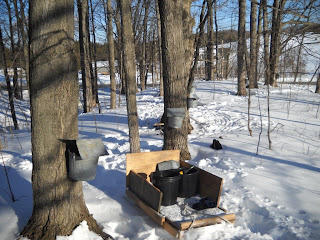
It's officially spring, or at least late winter. On March 3rd, I sowed 4 flats of alliums in the greenhouse (at work, sshhh!), and on March 4th, I tapped 31 of our sugar maples. In a week, we had collected almost 90 gallons of sap; a slow start. The next week, we got 26. Then the night temperatures stayed above freezing thanks to unseasonably warm weather, the flow just about stopped. I sowed tomatoes in soil blocks tonight (at home this time), and the temps have been falling. Things are looking good for the next few days, and the moon is waxing for another week, so I'm hoping for a good run. Meanwhile, the garlic, rhubarb and daffodils are poking their heads up.


The sled is made from found lumber and some old skis.

This time of year is a strange mix of activities. Planting, waiting, planning, watching, gathering & boiling. Wonderful rituals, and good honest work. It feels so good to be outside every day, especially hauling buckets of sap. Last year, we collected over 300 gallons and drove every drop to the family sugar shack 25 miles away. Lots of work, but we brought home over 7 gallons of syrup. We just made it, too; I opened the last pint two days ago!


Thanks, maples, for a sweet gift.

Tuesday, February 16, 2010

A REALLY HOT Investment Idea!

In light of recent economic turmoil, with government bailouts and banks "too big to fail", we can see more plainly that greedy bankers and investors are using our money to gamble. They're not taking our cash to the casino, rather they're betting our retirement and pension contributions on the stock market and shady mortgage deals. Of course they're trying to bet on "sure winners" so they, I mean we, get the largest possible return. Here in the state hit worst by the collapse of the auto industry, I'm not pretending there will be much of a retirement fund when I get there. I won't be putting cash in jars and buryin' it in the backyard, but my savings will end up in the ground.

Then we add another great folly of our time: biomass fuels. Recently, we discovered that when you burn food for fuel, the food, corn in this case, becomes a commodity. Well, OK, corn already was. Our American appetite for motor fuel almost took the corn tortilla out of Mexican culture. Our local power company is in favor of a biomass conversion plant, where who-knows-what would be burned to heat water to make electricity.

In another column, soil fertility has been declining for years. That corn probably wasn't worth eating anyway, so poor was its mineral content. Thanks to the Haber process, we have a handy way to make nitrogen fertilizer out of, guess what ... natural gas. Thus, our soil fertility program is tied to the price of fossil fuels, and subject to international disputes (see Russia vs. the rest of Europe). While nitrogen fertilizer gets more and more expensive, we mine the mineral apatite as a phosphorus source. While you're waiting for Peak Oil, keep an eye out for Peak Apatite!
I have another idea. Listen carefully 'cause I'm only gonna say this once, "Invest in the soil!"I repeat, "INVEST IN THE SOIL!"

Here in northern Michigan, one does not need to look far to find a farm that would have benefitted from the advice of Bill Mollison and David Holmgren, the founders of permaculture, instead of the advice of John Deere, the inventor of the moldboard plow. It all comes back to those teeming millions of bacteria in the soil. When soil is disturbed (plowed, disced, rototilled), the foods for the bacteria get homogenized. It's like a dirt smoothie, and they can get all they need very easily. They grow like crazy, and as they grow, they consume organic matter. When the forests up here were logged and the land sold to immigrant with dreams of farms, the plows mixed the soil and the bacteria ate that precious 2-3 inches of topsoil. The potatoes yielded less and less, and the immigrants left for town, my ancestors among them. Nature has been trying to repair the loss ever since, with spotted knapweed and autumn olive, among other remedies.

Let's learn from history. We are living in an exciting wave of new agriculture: small farms, local markets, caring people. Those of us with gardens are right there with them. We are going to succeed in an era of high energy costs by our willingness to work at it. I offer one basic principle that farmers in India and China have been using for thousands of years: compost, compost, compost.

Organic matter in the soil increases water holding capacity, adds mineral ion exchange capacity, and provides homes and food to billions of microrganisms that provide plants with slow-release mineral nutrition in just the right form. Translated, this means, if your soil is rich in organic matter, you don't need to water as often, any nutrients you apply will stay in the soil instead of leaching out with rains, and you probably won't need to apply fertilizer anyway. On the balance sheet, soil organic matter adds up to work you don't have to do!

Here's my great investment idea: on the tiny cultivated fraction of my 6 acres, I'm going to work on building soil organic matter. Household food scraps and garden trimmings go in the compost. The compost will, of course, go on the garden. The worm bin gets shredded paper and junk mail (no shiny inserts of course). The worm castings will be made into high-quality compost tea and potting mix. Leaves, lawn clippings and such get piled in windrows on ground that will someday be garden. Soon, we'll have some cute little furry manure producers (a.k.a bunnies) who will add to the garden soil. After much permaculture reading, I've adopted a greater tolerance for autumn olive, a nitrogen-fixing shrub. I also plan to add more of the soil-building plants listed by Toby Hemenway in Gaia's Garden. If I can swing it, nothing organic will leave this place!

We shouldn't burn biomass for energy if we can help it. Since burning adds yet more CO2 to out beleagured atmosphere, we shouldn't burn ANY plant material, paper, cardboard, etc. that could be used another way. As individual landowners, even small ones, and as communities, we need to invest in the land that might sustain us. I say "might" because we've neglected this savings account for more than 50 years, and we're paying the price. Our land is our best investment. Carefully tended, it will provide riches in the form of good food for years to come.

So start a backyard compost pile or worm composting system. Everything, I mean EVERY thing that will rot needs to go in a compost pile, or be spread lovingly on the land in a sheet mulch. If we produce more compostables than you can use, we need to find a way to get them back to the farms that support us. In an ecosystem, all matter is recycled within the system. So must it be with our communities as well.

Monday, February 8, 2010

It's Almost Time ...

Groundhog Day, the sun climbing a little higher in the sky, a bit of warmth ... all signs that maple syrup season is not far off. The next wave of days when the temperatures get above freezing should get things started.


We got the buckets out of storage in the pole barn. Next we bleach them and rinse them. Then wewatch the forecasts.


LR and I asked one of the trees, "Is it time yet?" The tree replied, "ARE YOU CRAZY??"
I'm planning to add about 12 more trees to the Sugar Trail, as we call it; we could end up with about 50 gallons of sap per day. We'll be boiling at a friend's shack this year. Next year, I hope to boil here. Anybody know of a small evaporator for real cheap?
Soon, the hours of trudging through snow with heavy buckets, breathing the steam heavy with the scent of syrup, smelling of woodsmoke for days. Soon, drinking the sap as a ritual spring tonic, flushing out the crud of winter like so much dirty snow. Soon ...

Sunday, December 20, 2009

Happy Yule!


On this the longest night of the year, Winter is fully upon us. The garden is buried under the first foot of snow. The bee hives are insulated with several inches of straw , held in place by sections of last year's pea trellis. This will protect them from the winter winds, and the hives have upper entrances for the bees to use when the snow covers the lower one.
To our ancient ancestors in northern Europe (and other times and places), this was the day the Earth Mother gave birth to the Sun Child. He will eventually grow stronger and brighter as the year progresses. This year, we followed a suggestion in Celebrating the Great Mother by Cait Johnson and Maura Shaw, and we built a sacred cave. Their cave calls upon the power of stones, but since we live in northern Michigan, we called upon the power of snow. Our Earth Mother holds her babe, while our totem animals stand at her feet. LD's owl perches on the roof of the cave. She wears the black robe of a crone, tied with red, for motherhood. The glow of the candles holds our eyes and imagination as we watch from the house.

If we can get the kids up, we'll climb the hill with drums and noisemaking devices to wake up the sun. That's a big "if" since they were playing with friends until nearly 10 p.m.!


So on this Longest Night, feel the quiet and the peace. Know that after tomorrow, the days start getting longer again. Rest in the darkness for work will return with the light. We would all do well to stop multi-tasking and just breathe. I raise a glass of homemade hard cider and give thanks to the Earth Mother, to the humans I love, and to the land that gives me sustenance. To all I say "Wassail!"

Monday, November 16, 2009

Yes, it makes a difference

I sat on a panel of academic "experts" this evening, sharing opinions and thoughts about ways to "green" our fine institution of higher learning. The question came up as to whether or not a single person's efforts to recycle make any difference. Indeed, often it feels like it doesn't. My moment of insight went something like this:

" A single visit to a flower by a single bee may not seem like much, since it only brings back a tiny bit of nectar. But if thousands of bees each visit a few flowers each hour, and if they do that for several hours each day, soon they can make enough honey to ensure the survival of the hive."

So when you feel like it's just not enough, remember that there are LOTS of bees out there working fo the same thing you are. Do what you can, every day, and soon we'll have enough honey to get through whatever lies ahead.

Namaste!
(LR's message to the world on our front walk ...)
Tuesday, November 10, 2009

Transitioning in coffee shops

Found this video via another blog and got inspired.


There are people who get it! We're just not satisfied with what the global marketplace wants to sell us. We'd rather see our money stay in the community and help friends and neighbors.

The thing that caught my attention the most about Whidbey Island is the monthly potlucks. Neighbors get together, actually. How many of us do that, even within a community like Bioneers? We see each other at meetings, but when can we just get caught up? I'm thinking we need a way or a place to, how shall I say, gossip! That is, gossip for the greater good! Have you ever been in a local restaurant with a table of local guys (I guess women have too much work to do) who sit around and talk over coffee every day? I know of one such place where the table is occupied from before 7 a.m. till after 9 with a changing parade of regulars. Those guys end up knowing everything that's going on in town.

Yes, Bioneers and social movers, we need a place to sit down over coffee or herbal tea and share what's going on. Had I known about cherry farmers dumping their crops on the ground I would have dropped everything and made buckets of cherry jam! How shall we keep each other informed? I suppose Facebook and Twitter have evolved to fill that role somewhat, but I hold them to be very poor substitutues. So much good stuff comes up in casual conversation. How much trust and relationship can you build posting 140-word tweets? The only tweets I want to hear come from my bird neighbors on spring mornings!

So where shall we meet? Let's keep posting, because few of us are retired or self-employed, or are full-time farmers who "take a break" about 9 a.m., but let's find a way to come together once a month, just for fun, with no agenda. If you can only drop by for a minute, that's fine. The pot of shade-grown, organic, fair-trade coffee is always on!

An early Thanksgiving

After a cold October, we're getting a few days of nice weather. We have even shut the pellet stove off during the daytime for 3 days now. All those deer in their winter coats must be panting! The bees have been out, too. We've seen several drinking at the pond, and the hive entrances are crowded. There are still a few drones getting the boot. I cut upper entrances for both hives, just a 4-5" wide slot in the edge of the inner cover, overhung by the outer cover. When (not if) the snow gets deep, they'll have a way out.

The garden is basically done except for a few greens in the cold frame. I picked parsley for a lentil & sweet potato casserole the other night. As Thanksgiving approaches, we're contemplating how to celebrate. The usual over-indulgent dinner with family just doesn't have any appeal. We're thinking of trying a 100-mile Thansgiving in the spirit of Michael Pollan's homemade local dinner in Omnivore's Dilemna, eating only things we can get from a 100-mile radius. There goes the sweet potatoes!

In the tradition of Thanskgiving, I'd like to publicly thank some of those who fed us this year. Some of you are good friends, and some are becoming such. We owe you much, farmers, so thanks to you (in no particular order):
  • John Sullivan for eggs
  • Jim Moses and Linda Grigg of Forest Meadow farm
  • Sandy & Bernie Ware for strawberries, potaotes, and many other good things
  • the kind folks at Second Spring Farm
  • Laurie Brown for honey, fruit, and tomatoes
  • Jayne Leatherman-Walker for tomatoes and great vibes
  • Hochstettlers for peppers
  • Alan Jones for those fantastic pears
  • Maple Ridge Farm for grass-fed meat and granola
  • another local organic farm for cilantro
  • Shangri-La farm for apples
  • Ebert March for carrots, squash & beans
  • Millie Hathaway for rhubarb
  • Marty & Michelle of Birch Point farm
  • Good Neighbor Orchard for organic apples that went into some of my finest applesauce

There are many, many others, of course, who provided us with grains, flours, oils, all those things we buy at the conventional grocery. Thanks to you all; we'll help you keep up the good work! It's a joy to hand my hard-earned dollars to someone who has worked even harder for it.

Last but not least, I'd like to thank the soil of Snowy Hollow, my own place, for providing us with tomatoes for sauce in spite of the anonymous fungal disease, carrots, tons of raspberries, cabbage, parsley, peas, and especially maple syrup! Rest well, and next year I'll try to give back even more.